Facebook
 X
 Pinterest
 Copy Link

Trying to figure out how much cash you need to buy a home in Michigan can feel confusing at first.
You might hear one person say you need 20 percent down. Someone else may tell you they bought with much less. Then you start hearing about closing costs, earnest money, inspections, appraisals, prepaid taxes, insurance, and reserves.
It is a lot.
The good news is that buying a home in Michigan may be more achievable than many buyers think. The key is understanding what money is needed, when it is needed, and which costs are part of the purchase versus ongoing homeownership.
If you are planning to buy in Southeast Michigan, including Ann Arbor, Canton, Plymouth, Northville, Novi, Livonia, Ypsilanti, Pittsfield Township, or nearby communities, this guide will help you think through the cash side of buying a home with more clarity.
The Main Cash Expenses When Buying a Home in Michigan
When buyers ask, “How much money do I need to buy a house?” they are usually thinking about the down payment.
That is only one part of the picture.
Most Michigan buyers should plan for these main categories:
- Down payment
- Closing costs
- Earnest money deposit
- Inspection and appraisal related costs
- Moving and post-closing reserves
The exact amount depends on your loan type, purchase price, lender, taxes, insurance, and how your offer is negotiated.
Do You Need 20 Percent Down to Buy a Home in Michigan?
No, not always.
This is one of the biggest misconceptions buyers have.
A 20 percent down payment can be helpful because it may lower your monthly payment and may help avoid private mortgage insurance on some conventional loans. But many buyers purchase homes with less than 20 percent down.
Depending on qualifications, some buyers may use loan options with lower down payment requirements, such as certain conventional loan programs, FHA loans, VA loans, USDA loans, or Michigan down payment assistance programs.
The right loan option depends on your credit, income, debt, savings, property type, location, and long-term plan.
This is why the first step should not be guessing from online calculators. The first step should be speaking with a trusted local lender who can review your actual numbers.
Common Down Payment Options Buyers Ask About
Here is a simple overview.
Conventional Loans
Some conventional loan programs may allow qualified buyers to purchase with a lower down payment, sometimes as low as 3 percent, depending on the program and borrower eligibility.
Conventional loans are common in Southeast Michigan, especially for buyers with stronger credit and stable income.
FHA Loans
FHA loans are often discussed with first-time buyers because qualified borrowers may be able to purchase with a down payment as low as 3.5 percent.
FHA loans also have specific property condition standards, mortgage insurance requirements, and lender guidelines. They can be a good fit for some buyers, but they are not automatically the best fit for everyone.
VA Loans
Eligible veterans, service members, and certain surviving spouses may qualify for VA financing. Many VA-backed loans are made with no down payment, although buyers should still plan for other costs such as inspections, appraisal-related expenses, closing costs, and reserves.
USDA Loans
USDA loans may be available for eligible buyers and eligible properties in qualifying areas. Not every Southeast Michigan location or property qualifies, so this needs to be checked carefully with a lender.
Michigan Down Payment Assistance
Michigan buyers may also want to ask about MSHDA programs and other down payment assistance options. These programs can be helpful, but they have rules, income limits, location requirements, lender requirements, and funding availability.
Do not assume you qualify or do not qualify without checking.
What Are Closing Costs in Michigan?
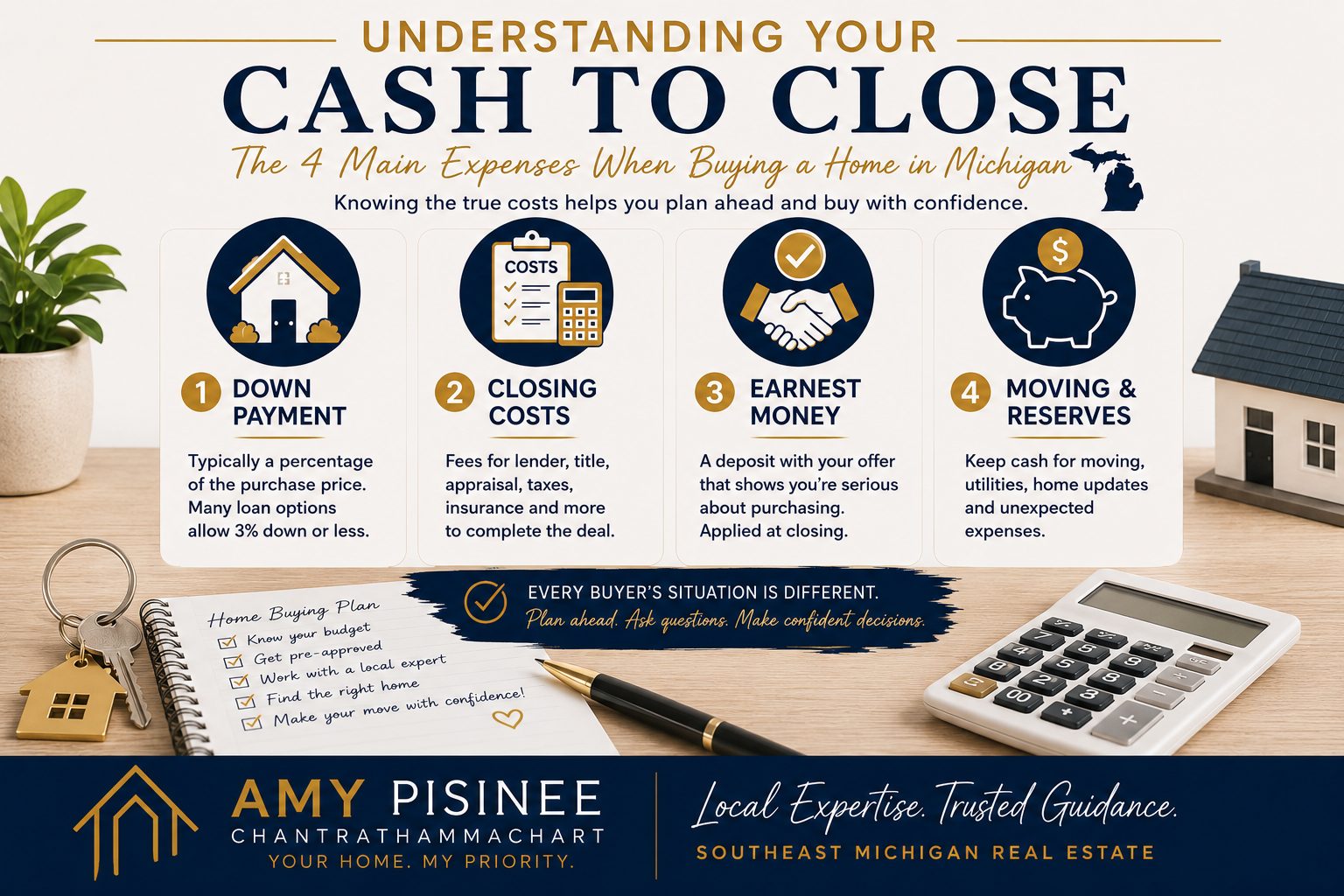
Buying a home involves more than just a down payment. Understanding each expense can help Michigan buyers plan with confidence.
Closing costs are the expenses required to complete the purchase and mortgage transaction.
They are separate from your down payment.
For Michigan buyers, closing costs may include items such as:
- Lender fees
- Appraisal fee
- Credit report fee
- Title services
- Lender’s title insurance
- Recording fees
- Prepaid homeowners insurance
- Prepaid property taxes
- Escrow account setup
- Mortgage insurance or funding fees, depending on loan type
Your lender is required to provide a Loan Estimate after you apply for a mortgage. This document helps show the estimated interest rate, monthly payment, and total closing costs.
Later in the process, you will receive a Closing Disclosure before closing. This shows the final loan details and costs. If you are wondering what happens on closing day in Michigan, understanding the final steps ahead of time can help make the experience feel much more manageable.
The important thing to remember is this:
Your down payment is not the same as your cash to close.
Cash to close usually includes your down payment, closing costs, and prepaid items, minus any credits or deposits that apply.
What Is Earnest Money in Michigan?
Earnest money is a deposit submitted after an offer is accepted. It shows the seller that the buyer is serious about moving forward.
In many Michigan transactions, earnest money is held by a broker, title company, or another agreed-upon party according to the purchase agreement.
The amount varies depending on the purchase price, local expectations, and offer strategy.
For example, a buyer writing on a competitive home in Ann Arbor, Plymouth, Canton, Northville, or Novi may approach earnest money differently than a buyer writing on a property with less competition.
Earnest money is usually credited toward the buyer’s costs at closing. It is not typically an extra cost on top of everything else, but buyers should understand the contract terms before submitting an offer.
This is one of those details where having a careful agent matters.
Inspection and Appraisal Costs
Buyers should also plan for inspection and appraisal-related expenses.
A general home inspection is usually paid by the buyer directly to the inspector. Depending on the home, buyers may also choose additional inspections, such as radon, sewer scope, pest, well, septic, chimney, or specialized inspections.
Not every property needs every inspection. It depends on the home, location, age, features, and buyer concerns. Learning more about the Michigan home inspection process can help buyers understand what inspectors typically review and how inspection contingencies work.
In Michigan, older homes in communities such as Ann Arbor, Ypsilanti, Plymouth, Northville, and Livonia may have different inspection considerations than newer construction or newer subdivisions.
That does not mean one is better than the other. It simply means buyers should understand the property they are purchasing.
The appraisal is typically ordered through the lender during the loan process. The appraisal fee is often paid by the buyer, either upfront or as part of closing costs, depending on lender practice.
Prepaid Taxes and Insurance Can Surprise Buyers
One area buyers sometimes overlook is prepaid items.
When you buy a home with a mortgage, your lender may require you to prepay certain items at closing, such as homeowners insurance and property tax escrow reserves.
In Michigan, property taxes matter. Tax amounts can vary by city, township, school district, millage rates, taxable value, and whether the home has been recently transferred.
A buyer purchasing in Ann Arbor may see a different tax picture than a buyer purchasing in Canton, Plymouth Township, Northville Township, Novi, Livonia, or Ypsilanti Township.
This is why it is important to review estimated taxes with your lender and not rely only on the current owner’s tax bill.
How Much Cash Should You Keep After Closing?
This part is very important.
Buying a home is not just about getting to the closing table. It is also about feeling comfortable after you move in.
I usually encourage buyers not to spend every available dollar on the purchase if they can avoid it.
After closing, you may need money for:
- Movers
- Utility setup
- Furniture
- Window treatments
- Paint
- Lawn care equipment
- Small repairs
- Appliances
- Emergency savings
Even a well-maintained home can have normal homeowner expenses shortly after closing.
This does not mean you should be afraid to buy. It simply means you should plan realistically.
Example: What Cash Needed Might Look Like
These are simplified examples only. Your actual numbers will depend on your lender, loan type, taxes, insurance, purchase agreement, and closing date.
Example 1: Buyer Purchasing Around $250,000
A buyer using a lower down payment loan may need cash for the down payment, closing costs, inspections, appraisal, and reserves.
Depending on loan type and available credits, the total cash needed could be much lower than 20 percent down, but it is still more than just the down payment.
Example 2: Buyer Purchasing Around $400,000
A buyer purchasing around $400,000 may choose between putting less down and keeping more cash available, or putting more down to reduce the monthly payment.
Neither choice is automatically right or wrong.
It depends on monthly comfort, savings, income stability, and long-term goals.
Example 3: Buyer Selling and Buying
A buyer who is also selling a home may use proceeds from the sale toward the next purchase.
This can create more flexibility, but it also requires careful planning around timing, possession, appraisal, inspection, and closing dates.
This is especially important in Southeast Michigan when buyers are trying to coordinate a sale and purchase at the same time. If you will be selling before purchasing your next home, preparing your home before listing may help maximize your proceeds and give you a clearer picture of the funds available for your next purchase.
Can Seller Concessions Reduce Cash Needed?
Sometimes, yes.
A seller concession is when the seller agrees to contribute toward certain buyer closing costs or prepaid expenses, subject to loan guidelines and negotiation.
Seller concessions can help reduce the buyer’s cash needed at closing.
However, whether this is realistic depends on the property, price, buyer demand, and current market conditions.
In a competitive situation, asking for seller concessions may make an offer less attractive. In a slower or more balanced situation, it may be more reasonable.
This is where strategy matters.
The goal is not just to write an offer. The goal is to write an offer that fits the buyer’s financial picture and still makes sense in the market.
What Buyers Should Do Before Touring Homes
Before spending weekends touring homes, it helps to know your numbers.
Here is the process I recommend:
Step 1: Talk to a lender
A lender can estimate your down payment, closing costs, monthly payment, and cash to close.
Step 2: Decide your monthly comfort level
Just because you qualify for a certain amount does not mean you have to spend that much.
Step 3: Review your available cash
Think about down payment, closing costs, inspections, moving expenses, and reserves.
Step 4: Understand the local market
A $350,000 home in one Southeast Michigan community may have a different tax picture, HOA cost, condition, or competition level than a similarly priced home somewhere else.
Step 5: Build a plan before writing offers
This is where your lender and agent should work together.
The best plan considers both financing and offer strategy. If this is your first purchase, understanding the home buying process in Michigan can help you know what to expect from pre-approval through closing.
Questions Buyers Often Ask
Is earnest money the same as a down payment?
No. Earnest money is a deposit made after your offer is accepted. It is usually credited toward your costs at closing.
Are closing costs paid upfront?
Some costs may be paid before closing, such as inspections or certain lender-related fees. Many closing costs are paid at closing as part of your cash to close.
Can I use gift funds?
Some loan programs allow gift funds, but there are documentation rules. Always check with your lender before moving money.
Should I wait until I have 20 percent down?
Not necessarily. For some buyers, waiting makes sense. For others, buying sooner with a lower down payment may be reasonable. It depends on your finances, comfort level, and goals.
Can I buy a home with very little cash?
Some loan programs and assistance options may reduce the amount of cash needed, but buyers should still plan for inspections, appraisal-related costs, moving expenses, and reserves.
Final Thoughts
The real answer to “How much cash do I need to buy a home in Michigan?” is this:
It depends, but it should never be a mystery.
A good plan will show you the down payment, estimated closing costs, prepaid items, inspection costs, earnest money, monthly payment, and what you may want to keep in savings after closing.
That clarity can make the whole process feel much calmer.
If you are thinking about buying in Ann Arbor, Canton, Plymouth, Northville, Novi, Livonia, Ypsilanti, Pittsfield Township, or surrounding Southeast Michigan communities, you do not have to figure it out alone.
I can help you understand the process, connect you with trusted local lenders, and talk through what makes sense before you feel pressured to make a move.
Sometimes the best first step is simply looking at the numbers.
Thinking about buying or selling but not sure where to start? Let’s chat and make your next move happen together.