Facebook
 X
 Pinterest
 Copy Link

If you own an investment property in Michigan and are thinking about selling, taxes may be one of the biggest considerations in your decision.
Selling a rental property can trigger capital gains taxes and potentially depreciation recapture. For some investors, a 1031 exchange may provide a way to defer certain taxes while reinvesting in another qualifying property.
But a 1031 exchange isn’t as simple as selling one property and buying another. There are strict IRS requirements, important deadlines, and decisions that need to be made before your current property closes.
Here’s what Michigan real estate investors should understand before getting started.
1. What Is a 1031 Exchange, and How Does It Work?
A 1031 exchange, named after Section 1031 of the Internal Revenue Code, allows an investor to defer recognition of certain capital gains when selling qualifying investment or business real estate and acquiring other qualifying real estate.
Instead of receiving the sale proceeds directly, the investor generally works with a qualified intermediary who holds and transfers the exchange funds according to IRS requirements.
For example:
An investor owns a rental property in Canton and wants to sell it to purchase another investment property in Ann Arbor or Ypsilanti.
If both properties qualify and the exchange is properly structured, the investor may be able to defer federal capital gains taxes associated with the sale.
Important: A 1031 exchange generally defers taxes rather than eliminating them. Some gain may still be taxable if the investor receives cash or other nonqualifying property.
2. Which Michigan Properties Qualify for a 1031 Exchange?
Not every real estate transaction qualifies.
Under current federal rules, Section 1031 generally applies to real property held for investment or productive use in a trade or business.
Examples of potentially qualifying properties include:
-
Single-family rental properties
-
Multifamily rental properties
-
Commercial buildings
-
Investment land
-
Certain business-use real estate
The replacement property does not have to be identical to the property being sold.
For example, an investor might exchange a rental condominium in Novi for a duplex in Ypsilanti, provided the properties meet the applicable requirements.
However, properties held primarily for personal use, such as a primary residence, generally do not qualify. Property held primarily for resale, including typical fix-and-flip inventory, generally does not qualify either.
Michigan-specific consideration: The exchange does not have to remain within Michigan. A qualifying Michigan investment property can potentially be exchanged for investment real estate in another state. For investors considering their next purchase, understanding what to know before buying your first investment property in Southeast Michigan can help with evaluating potential replacement properties.
3. The Two Deadlines Investors Cannot Afford to Miss
One of the most important parts of a 1031 exchange is understanding the timeline.
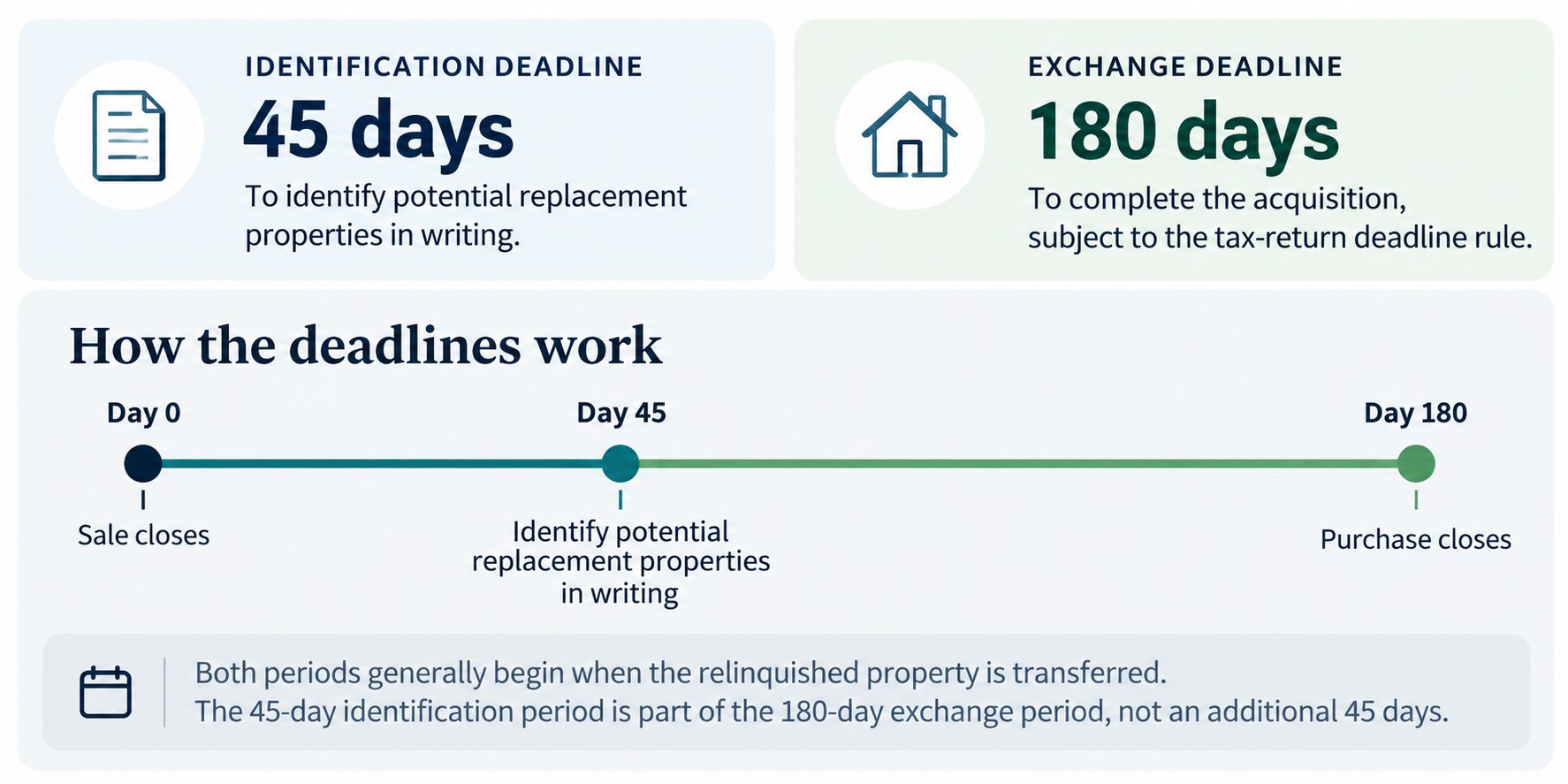
A 1031 exchange has two critical deadlines: 45 days to identify replacement properties and up to 180 days to complete the exchange.
The replacement property must generally be received by the earlier of 180 days after the relinquished property’s transfer or the due date of the investor’s federal tax return, including extensions, for that tax year.
Missing a deadline can cause the exchange to fail, potentially resulting in unexpected taxes.
That is why investors should begin evaluating replacement properties before listing their current investment property.
4. Why a Qualified Intermediary Matters
In a typical deferred 1031 exchange, investors use a qualified intermediary, often called a QI, to facilitate the transaction.
The intermediary helps structure the exchange, coordinates the exchange documents, and handles the proceeds according to the exchange agreement.
An investor generally cannot simply receive the sale proceeds, deposit them into a personal account, and later decide to complete a 1031 exchange.
There are also IRS restrictions on who can serve as the qualified intermediary. Certain related parties and people who have recently acted as the investor’s agent may be disqualified.
Before selling, investors should coordinate with a qualified intermediary, CPA or tax advisor, real estate attorney when appropriate, and real estate agent.
The right professionals need to be involved before the transaction is structured, not after the sale has closed.
5. Michigan Property Taxes and Other Costs Still Matter
A 1031 exchange can offer federal tax-deferral benefits, but it does not eliminate the ordinary costs of selling and purchasing Michigan real estate.
Investors should evaluate:
Michigan property tax uncapping
Michigan property taxes can change following a transfer of ownership. A transfer generally uncaps the property’s taxable value in the following calendar year unless an exception applies.
A buyer should not assume the seller’s current tax bill will continue after closing.
Principal Residence Exemption (PRE)
Michigan’s Principal Residence Exemption generally applies to qualifying owner-occupied principal residences, not ordinary investment rental properties.
Investors should verify the property’s current exemption status and expected taxes rather than assuming any existing exemption will continue.
Transfer taxes and closing expenses
Michigan real estate transactions may involve state and county transfer taxes, title costs, recording fees, financing expenses, and other closing charges.
A 1031 exchange does not automatically waive these expenses.
Rental regulations
If the replacement property will be rented, investors should also review applicable municipal registration, inspection, zoning, and rental requirements.
Rules can differ among communities such as Ann Arbor, Ypsilanti, Canton, Novi, and Northville. Beyond taxes and closing expenses, investors should also consider how much to budget for home maintenance in Michigan when estimating the long-term costs of owning a rental property.
These expenses and requirements can affect the property’s long-term performance, regardless of whether the exchange qualifies for tax deferral.
6. Common 1031 Exchange Mistakes to Avoid
A successful exchange requires more than finding another property.
Some common mistakes include:
-
Waiting until after closing to contact an intermediary. By then, it may be too late to structure a standard deferred exchange.
-
Underestimating the replacement property’s total cost. Taxes, insurance, repairs, and financing can change the investment calculation.
-
Assuming any replacement property qualifies. The property’s intended use and other IRS requirements matter.
-
Receiving exchange funds directly. This can jeopardize tax deferral.
-
Missing the identification or completion deadline. The IRS rules are strict, with only limited exceptions.
-
Assuming all taxes will be deferred. Debt relief, cash received, and other transaction details can create taxable gain.
Investors seeking full deferral generally need to reinvest all net exchange proceeds and acquire sufficient replacement property value, while also addressing debt and other consideration appropriately. The precise calculation should be reviewed with a tax professional.
7. Is a 1031 Exchange the Right Move for You?
A 1031 exchange can make sense for an investor who wants to reposition an existing real estate investment while deferring certain taxes.
For example, an investor may want to sell a rental property that requires significant maintenance and purchase another property that better fits their investment goals.
Others may want to consolidate several investments or diversify into different types of real estate. If you’re deciding what type of property to purchase next, comparing single-family homes and condos as investment properties may help you evaluate maintenance responsibilities, rental potential, and long-term ownership costs.
However, tax deferral alone should not determine whether a property is worth purchasing.
Before moving forward, consider:
-
Does the replacement property support your investment goals?
-
What are the expected operating costs and potential rental income?
-
Will financing and available cash support the purchase?
-
Are you prepared for the exchange deadlines?
-
How does the tax benefit compare with the property’s overall financial outlook?
A replacement property should make financial sense on its own, not simply because it qualifies for a 1031 exchange. For homeowners who are considering becoming investors, another important question is whether to keep your current home as a rental when buying your next home in Michigan.
Frequently Asked Questions About 1031 Exchanges in Michigan
Can I use a 1031 exchange to buy a primary residence?
Generally, no. Replacement property must be held for qualifying investment or business purposes. Special rules may apply if the property’s use changes later, so investors should seek tax guidance before making plans to occupy it.
Can I exchange a Michigan rental property for one in another state?
Yes. Qualifying real property located in one U.S. state can generally be exchanged for qualifying real property in another U.S. state. Special restrictions apply to exchanges involving foreign real estate.
Do I have to purchase a more expensive property?
Not necessarily. However, purchasing a lower-value property or retaining some proceeds may result in a partially taxable exchange. A tax advisor should calculate the implications.
Can I use a 1031 exchange to buy multiple properties?
Potentially, yes. Investors may acquire multiple qualifying replacement properties, subject to the identification rules and other exchange requirements.
Does Michigan have its own 1031 exchange rules?
Section 1031 is a federal tax provision. Michigan generally follows the federal treatment of qualifying like-kind exchanges for state income-tax purposes, but state tax consequences and reporting should be confirmed with a Michigan-qualified tax professional.
Final Thoughts
A 1031 exchange can be a useful strategy for Michigan real estate investors who want to sell one investment property and purchase another without immediately recognizing all of the potential taxable gain.
But the timing, property selection, and transaction structure matter.
If you’re considering selling an investment property in Ann Arbor, Ypsilanti, Canton, Novi, Northville, or the surrounding Southeast Michigan area, it’s worth understanding your options before putting the property on the market.
I can help you evaluate local property options and coordinate the real estate side of the process while your tax advisor and qualified intermediary guide the exchange requirements.
Thinking about your next real estate investment in Southeast Michigan? Let’s talk about your goals and what options may make sense for you.